
June 12, 2026 · Mike Lopez
Stamped Concrete vs. Pavers: Which Is Right for Your Ohio Patio?
We install both. Real SW Ohio costs, freeze-thaw durability, maintenance, and how we tell clients to choose between stamped concrete and pavers.

If you want the lower installed cost and a single monolithic slab that shrugs off decades of Ohio winters, stamped concrete is the right call for most Southwest Ohio patios — it runs $14–22 per square foot installed versus $18–30 for pavers, and there are no joints for weeds or settling to exploit. Pavers earn their premium when repairability matters most: an individual unit can be lifted and replaced, which a stamped slab cannot match. Both handle Ohio freeze-thaw just fine when the base is built right — and the base is where most patios actually fail. We pour stamped concrete and we lay pavers at Ohio Valley Concrete & Hardscapes, so we have no horse in this race. Here is the same framework we walk Mason, West Chester, and Springboro homeowners through before they sign anything.
How much does a stamped concrete patio cost compared to pavers in Southwest Ohio?
Stamped concrete costs $14–22 per square foot installed in the Cincinnati–Dayton corridor, while paver patios run $18–30 per square foot installed — roughly 25–40 percent more for comparable size and site conditions. The gap comes from labor: stamping is a pour-and-imprint process, while pavers are placed one unit at a time over a compacted aggregate and sand base.
| Factor | Stamped Concrete | Paver Patio |
|---|---|---|
| Installed cost (SW Ohio) | $14–22 / sq ft | $18–30 / sq ft |
| 400 sq ft patio | $5,600–$8,800 | $7,200–$12,000 |
| Ongoing maintenance | Reseal every 2–3 years | Re-sand joints, weed control, occasional releveling |
| Repair approach | Patch or resurface section | Lift and replace individual units |
| Typical lifespan | 25–30+ years | 25–50 years with joint upkeep |
For a deeper line-item breakdown of each, see our stamped concrete patio cost guide and paver patio cost guide — both reflect what we actually charge in Warren and Butler County, not national averages.
Which is more durable in Ohio freeze-thaw and clay soil?
Both stamped concrete and pavers survive Ohio freeze-thaw cycles when they are installed over a properly compacted base with real drainage — and both fail early when they are not. Southwest Ohio sits on expansive clay soil that holds water, swells when it freezes, and heaves whatever is sitting on top of it. The material you pick matters less than what is underneath it.
A stamped patio done right means 4 inches of concrete at a minimum, fiber or rebar reinforcement, air-entrained mix rated for freeze-thaw, control joints cut on a sensible grid, and a compacted gravel base that drains. Done that way, the slab moves as one piece and resists frost heave as one piece. A paver patio done right means 6–8 inches of compacted aggregate, a screeded sand setting bed, edge restraint, and polymeric sand in the joints. Each paver can flex independently, which is forgiving — but it also means individual units can settle, tilt, or pop proud of their neighbors as the clay moves under them.
In our experience installing both across Mason, Lebanon, and Liberty Township, the honest summary is: a stamped slab is more likely to develop a hairline crack you can see, and a paver patio is more likely to develop a wavy, uneven surface you can feel. Control joints hide most concrete cracking; annual touch-up keeps pavers flat.
What maintenance does a stamped patio need compared to a paver patio?
Stamped concrete needs one recurring task: resealing every 2–3 years to protect the color and surface, at roughly $0.75–1.50 per square foot. That is the whole list. No joints means no weeds, no ant hills, and nothing to re-sand.
Pavers carry more frequent, smaller chores. Polymeric sand in the joints washes out over time and needs topping up every couple of years. Weeds and moss colonize joints that lose their sand. Edge restraints loosen. Individual units settle and need lifting and releveling. None of it is hard, but it never fully stops — and a paver patio that skips joint maintenance for five years looks far rougher than a stamped patio that skipped a sealing cycle.
- Stamped: reseal every 2–3 years; rinse as needed. Skipping it fades color but does not compromise the slab.
- Pavers: re-sand joints every 2–3 years, spot-treat weeds, relevel settled units, reset edge restraint as needed.
What design options do stamped concrete and pavers offer?
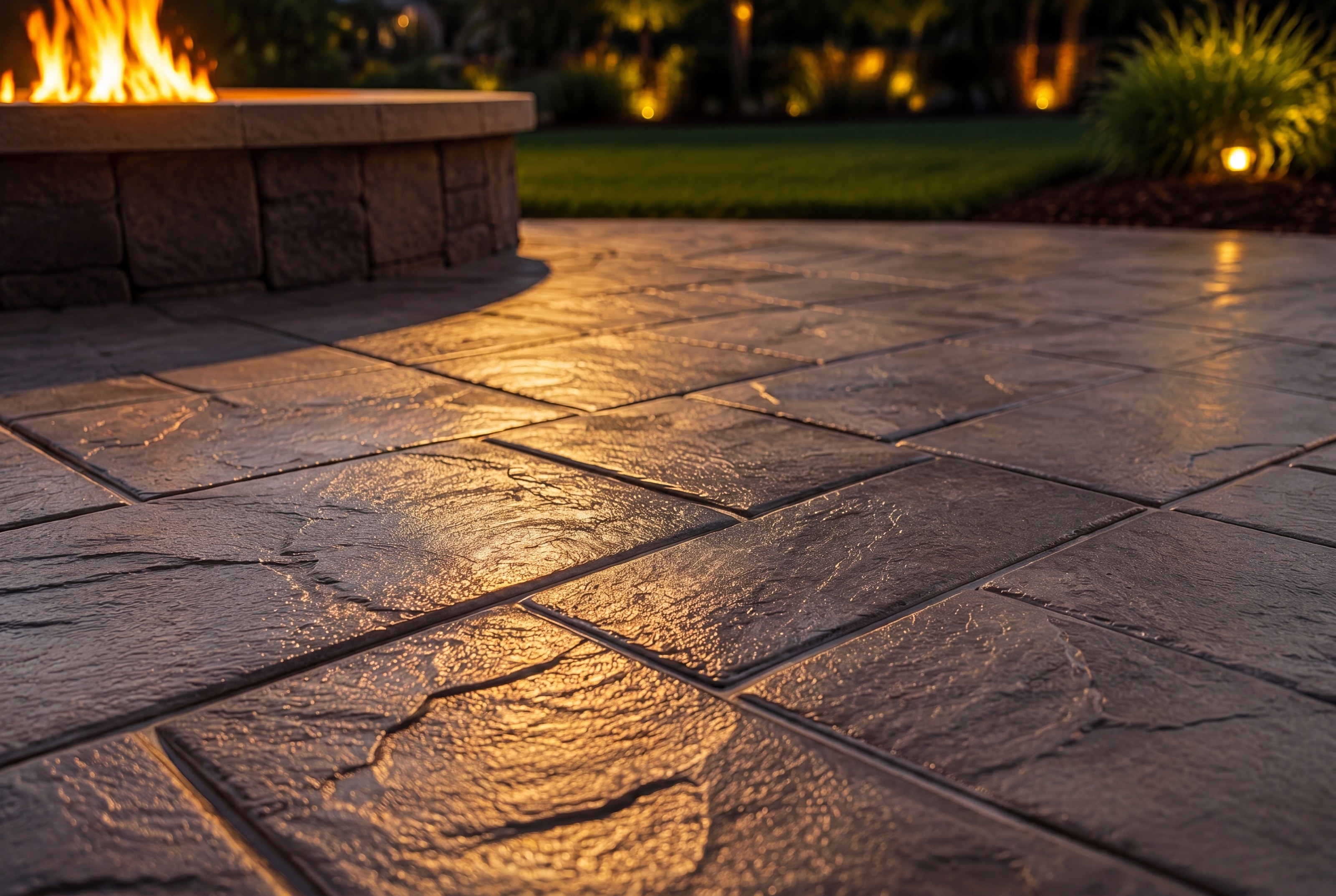
Stamped concrete offers the wider design range for the money because pattern and color are applied to wet concrete rather than purchased per unit. Our most-requested patterns are ashlar slate (a random cut-stone look), Italian slate (a finer natural texture), and wood plank — which convincingly mimics a wood deck with zero rot, splinters, or staining schedule. Integral color plus a contrasting release agent gives the surface depth that flat gray concrete never has, and borders, bands, and multiple patterns can be combined in one pour. See our stamped and decorative concrete service page for patterns we install locally.
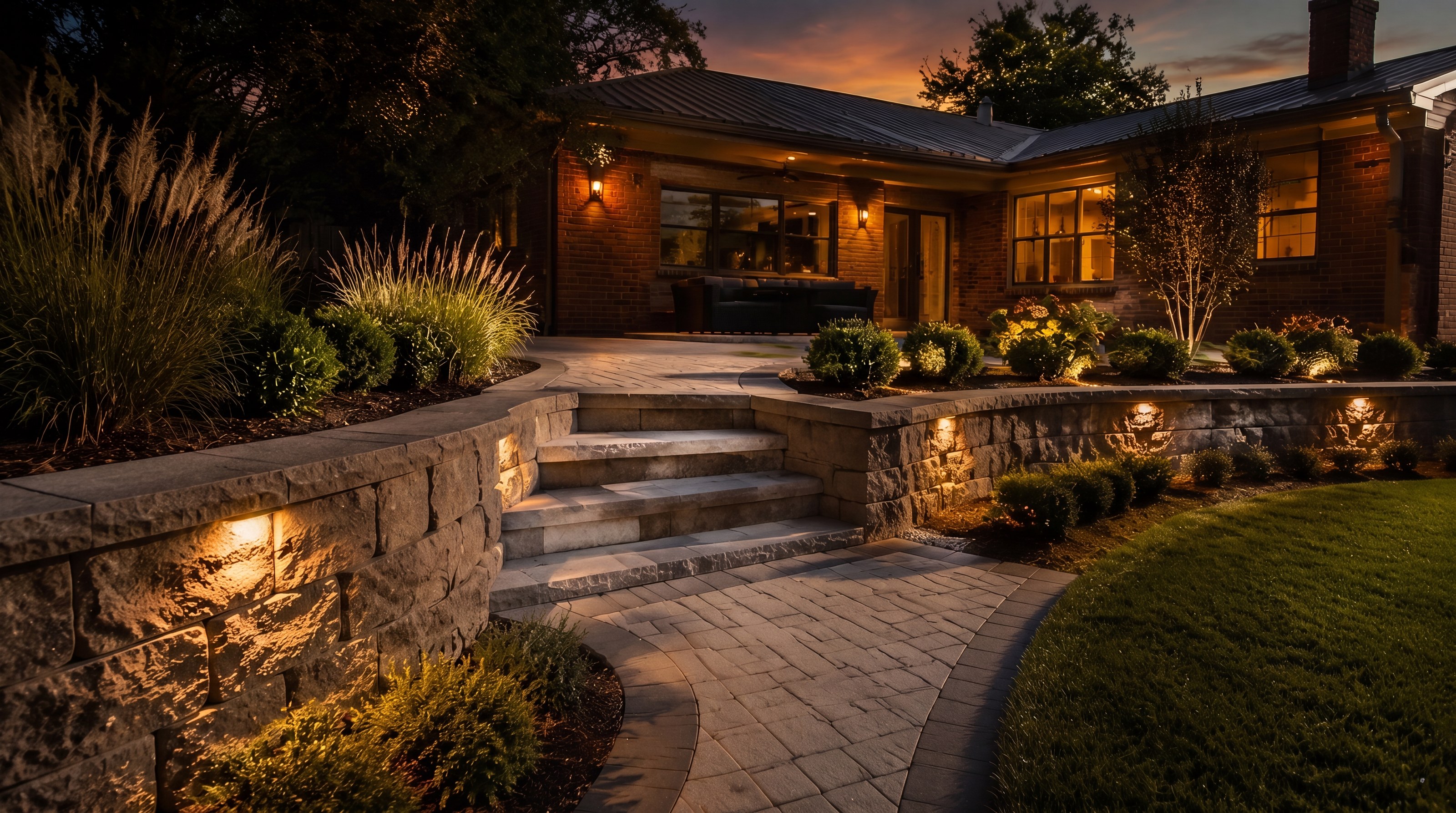
Pavers offer a modular, manufactured look with crisp unit lines — classic brick, cobblestone, and large-format modern slabs. Because each unit is factory-made, the color is consistent and the texture repeats. Pavers also pair naturally with other hardscape elements: seat walls, fire pits, and retaining walls built from coordinating block. If your vision is an outdoor room with walls, steps, and a fire feature, our hardscapes page shows how those pieces come together.
How do repairs differ between stamped concrete and pavers?
Pavers win on repairability, full stop. A stained, chipped, or settled paver can be lifted out and a new one dropped in — twenty minutes, near-invisible result if you kept spare units from the original install. That single advantage is why pavers justify their price premium for some homeowners.
Stamped concrete repairs are more involved. Hairline cracks within control joints are normal and largely cosmetic, but a crack that wanders across a stamped field cannot be invisibly erased — it can be filled, color-blended, and sealed, which makes it subtle rather than gone. Major settlement means cutting out and re-pouring a section, and matching a five-year-old color and pattern takes a skilled crew. This is the honest trade for the monolithic slab: fewer failure points, but bigger fixes when one happens. If you have existing concrete that is cracked or settled, our concrete patio team will tell you plainly whether it is repairable or due for replacement.
Which adds more resale value to your home?
Both add meaningful resale value, and in the Southwest Ohio market neither reliably outperforms the other — condition matters more than material. A well-maintained 400 square foot stamped patio and a well-maintained paver patio of the same size appraise similarly; a cracked slab or a weedy, wavy paver field both read as deferred maintenance and drag offers down. Outdoor living space consistently returns a strong share of its cost at sale in Mason, West Chester, and Springboro because buyers here expect usable backyard space. Spend your budget on proper base preparation and size rather than stretching for the premium material — a bigger, correctly built patio beats a smaller, fancier one at resale.
Which should you choose: stamped concrete or pavers?
Choose stamped concrete if you want the most patio per dollar, a seamless natural-stone or wood-plank look, and maintenance limited to resealing every few years. Choose pavers if unit-level repairability is worth a 25–40 percent premium to you, you prefer the modular look, or your design leans heavily on matching seat walls and fire features.
- Stamped concrete wins when: budget matters, you want large uninterrupted pattern fields, you do not want recurring joint upkeep, or you are matching an existing slab like a pool deck or covered patio.
- Pavers win when: you want the ability to swap damaged units forever, the patio integrates with block-built walls and steps, you may need future access to utilities under the patio, or you plan to expand in phases.
- Either works when: the installer builds the base correctly for clay soil. Neither survives a shortcut base — ask any contractor how many inches of compacted aggregate they install and how they handle drainage before you compare quotes.
Because we install both, our recommendation comes from your yard, your budget, and how you will actually use the space — not from the one product we happen to sell.
Ready to compare both options for your yard?
We will walk your site, talk through stamped and paver options side by side, and give you straight numbers for each — free, with no pressure. Ohio Valley Concrete & Hardscapes is a veteran-owned contractor based in Maineville, serving Mason, West Chester, Liberty Township, Lebanon, and Springboro. Call (513) 224-5586 or request your free estimate online.